Reading to Ruth › Advice for families
The local news, and the news from homeYour family's own talking newspaper
On New Year's Day 1970, about twenty blind people in Cardiganshire found a cassette tape on the doormat with the local news read out on it. It was Britain's first talking newspaper. There are now hundreds of them, and if your mum or grandad can't read the paper any more, one of them is probably round the corner.
What a talking newspaper is
A talking newspaper is the local news, read aloud by volunteers and recorded for people who can't read print. You'll usually get the main stories from the local paper, and many groups add a magazine as well. It's read by local volunteers, in voices that sound like home.
That first one in 1970 was started by Ronald Sturt, a librarian lecturing at the college of librarianship in Aberystwyth. He'd seen the idea on a visit to Sweden, went on to found what's now the national federation, and was given an MBE. The Cardiganshire paper is still going, now as Papur Sain Ceredigion, and it marked fifty years of publication in January 2020.
Since then the idea has spread to most corners of the UK. Deafblind UK puts the number at more than 300 local talking newspapers, made by around 9,000 volunteers. More than 290 of them can now be heard through one free app and Alexa skill alone. Most are small local charities, and the ones I've looked at cost the listener nothing.
How they arrive today
Cassettes have mostly gone (I'm slightly sad about that), but each group does things its own way. Between them you'll find:
- A USB stick in the post, usually weekly. Forth Valley's Newsline, for example, posts its sticks free under Royal Mail's Articles for the Blind scheme, and can lend a USB player to local listeners who haven't got one.
- A CD in the post, for listeners who aren't online.
- A phone line. Black Country Talking News, for one, has a number you ring to listen (it costs the price of a local call).
- The free Talking Newspaper app for phones and tablets, from British Wireless for the Blind Fund and the Talking News Federation.
- An Alexa speaker. Say "Alexa, open Talking Newspapers" and then ask for the paper by name.
- Online or as a podcast, for those who'd rather use a computer.
How to find your local one
If your dad has lost his sight and still wants to know what's going on in the town he's lived in for fifty years, this is where I'd start. It's free, it's local and it's made with real kindness.
- The Talking News Federation is the umbrella charity for local talking newspapers. Its talking newspaper finder lists them by area, with a map you can click on.
- RNIB's Sightline Directory lists sight loss services across the UK. Search the Sightline Directory for "talking newspaper" and the town.
- Ask the group how it's sent. A USB stick needs a player that takes one, and an app needs a phone they can manage. If the person can't work either, the phone line or a member of the family setting up the Alexa skill may be easier.
And if you've a decent reading voice and an hour or two a week, it's worth asking whether they need volunteers. Every one of these is kept going by people who turn up.
Reading to Ruth is not connected with the Talking News Federation, British Wireless for the Blind Fund, RNIB or any local talking newspaper. Alexa is a trade mark of Amazon. Details were checked in October 2026 and may have changed; check each organisation's own site.
The one thing the local paper can't tell her
A talking newspaper can tell your gran that the bypass is shut and the church fete raised a record sum. What it can't tell her is what her own family did this week: that you've finally finished the bathroom, that her great-grandson lost his first tooth, that her sister rang. When someone can't read, and especially when they can't get out much, that's the news they miss most and hear least.
Letters stop working when the eyes go. Phone calls happen, but they come one at a time and at odd hours, and if she's hard of hearing they can be more of a strain than a pleasure. So the family's week tends to arrive in bits, or not at all.
What you want is the talking newspaper idea, turned round: the family are the volunteers, and Gran is the only listener.
The Sunday bulletin I built for my grandmother
My grandmother Ruth is 101, almost completely blind and hard of hearing. She lives in a care home and listens to her books on a player I built for her, which turns a tablet into one big Play button. The player plays the family's voice messages before the story. The Sunday bulletin gathers a week of them up and gives them to her in one go.
- During the week, anyone in the family can save a voice message from their own phone, wherever they live. They can also paste in a letter, an article or a poem, and it'll be read aloud.
- On Sunday morning, she presses the same button she always does and hears it all together as this week's news from your family. Then it goes back to her story.
- On Thursday the family get an email saying what's in so far. If it's empty by Saturday, there's a reminder.
- If nobody adds anything, there's no bulletin that week. Nobody is ever handed an empty one.
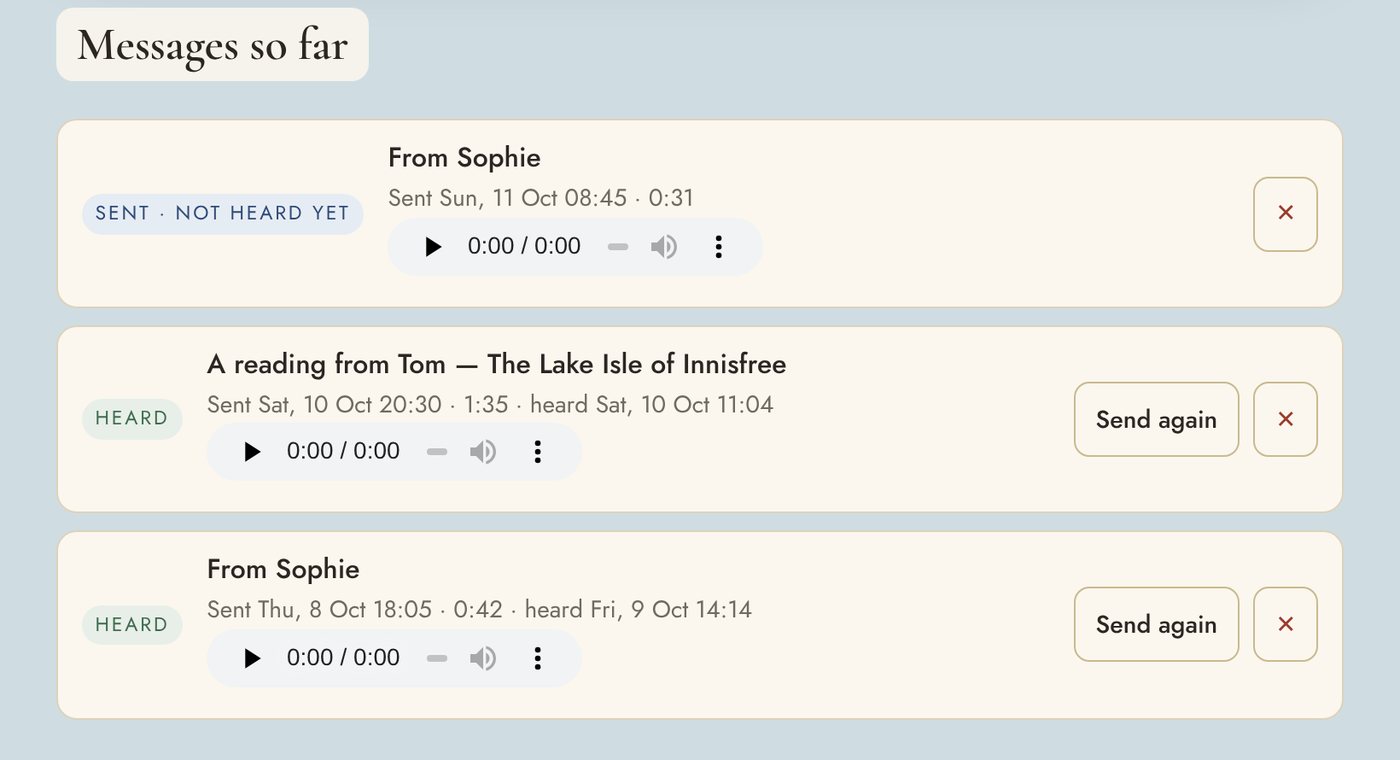
Voice messages are free and unlimited, and two hours of reading aloud are included. In a care home, the staff only have to keep the tablet charged; the family do the rest from their phones.
How to do it without Reading to Ruth
You don't need me for this, honestly. You need a regular time and one person at Gran's end. Here are the ways I'd try:
- Voice notes on WhatsApp. Make a family group, and ask everyone to send a short voice note during the week. Then on Sunday a visitor, a neighbour or a carer plays them through. If it's care staff, ask kindly and keep it short, because their time is stretched thin.
- The Sunday phone call. Pick one person to be the family's editor. They gather up everyone's news and ring at the same time each week to read it out, slowly. Put it on speakerphone if the handset is fiddly.
- A recording. Record the week's news on a phone's voice recorder, and have someone play it to her on a speaker she can hear. If she already has a USB player from her talking newspaper, ask the volunteers whether it will play a recording you've made yourself.
Whichever you choose, say who's speaking at the start, talk more slowly than feels natural, and keep each person's bit to a minute or two. The weak spot in all of these is the person in the middle: it works for as long as someone remembers to press play. That's the bit I wanted to take away for Ruth.
And keep the local talking newspaper too. The volunteers' paper and yours do different jobs, and she deserves both.
This week's news from your family, every Sunday.
One big button for them. Books, voice messages and a Sunday bulletin from the whole family, sent from your own phones.
Founding price until 31 December 2026, then £74.99.
Pay once — £49.99Cancel any time from the family page. The player keeps everything already on it.
Start monthly — £6.99Everything included either way, for the whole family. 60-day money-back guarantee on both, from the day they first use it.
Questions people ask
What is a talking newspaper?
A recording of local news, read aloud by volunteers for people who are blind, partially sighted or can't read print. Most are small local charities, and the first in the UK began in Cardiganshire in 1970.
Are talking newspapers free?
The ones we've looked at are free to listeners, and USB sticks posted under Royal Mail's Articles for the Blind scheme go free of charge. A phone line may cost the price of a local call. Ask your local group, as each one runs things its own way.
How do I find a talking newspaper near me?
Use the Talking News Federation's finder at tnf.org.uk, which lists local talking newspapers by area and on a map, or search RNIB's Sightline Directory for "talking newspaper" and your town.
Can I make a talking newspaper of family news?
Yes. Collect voice notes from the family through the week and have someone play them on Sunday, or ring and read everyone's news aloud. Reading to Ruth's Sunday bulletin does this on the player itself, with no one needed in the room.