Reading to Ruth › Advice for families
For activity coordinators, managers and families who visitCare home activity ideas that take almost no staff time
If you run activities in a care home, you're probably one person trying to reach everyone, including the residents who can't see the board, can't hear the quiz or would rather stay in their room. These are the ideas that ask very little of you once they're set up, and quite a few can be run almost entirely by families.
What CQC and NICE are looking for
"Meaningful activity" can sound like one more thing to evidence. It's simpler than that. CQC's quality statement on independence, choice and control expects that "people have access to activities and the local community to promote and support their independence, health and wellbeing", and that people are "supported to maintain relationships and networks that are important to them". (CQC's statement, last updated May 2024.)
NICE's quality standard on the mental wellbeing of older people in care homes says activity should be meaningful to the person, chosen with them, and that "whenever possible, and if the person wishes, family, friends and carers should be involved" (NICE QS50). That last line is good news for your week. The families are a team you haven't fully recruited yet.
Ten ideas that nearly run themselves
1. A personal playlist for each resident
Playlist for Life is a Scottish charity built on the idea that a playlist of personally meaningful music can help someone living with dementia. There's a free online Playlist Maker and a free starter pack, and it offers free resources and training to organisations. Ask each family to build the list: the song from the wedding, the hymn from school, whatever Dad always sang in the car. Your job is to press play, and to find headphones for anyone who's hard of hearing.
2. A radio station that plays their decades
m4dRADIO, from Music for Dementia, is free to listen to online and on DAB, with music from the 1940s to the 1990s. Put it on in a quiet lounge and leave it; it'll happily play all afternoon. Music for Dementia's site also has a section on music in care settings.
3. The local talking newspaper
Local talking newspapers are recorded by volunteers, and they're free for people who are blind or partially sighted. Recordings come on a memory stick by free post, or can be streamed on a tablet or a smart speaker. Find yours with the Talking News Federation's finder, sign up the residents with sight loss, and the news turns up every week or fortnight without you doing a thing. There's more in our guide to talking newspapers.
4. Reminiscence you can hold or hear
Daily Sparkle is a paid reminiscence newspaper with large-font, audio and non-English versions, and at the time of writing it's offering four weeks free to try. The Royal Mint Museum lends a reminiscence box to care homes free of charge: 15 objects, from a purse of pre-decimal coins to a 1953 Coronation Crown, which play audio clips when placed on a little unit. It's lovely for anyone who can't see the objects well. National Museums Liverpool's free My House of Memories app does something similar on a tablet. And it's always worth asking your local museum whether it lends handling boxes.
5. Audiobooks and family voices
RNIB Talking Books is free for people who are blind or partially sighted, and public libraries lend audiobooks free. (Our guides to audiobooks for the blind and free audiobooks in the UK cover the details.) There's no cheaper activity than a voice message from family: two minutes recorded on a phone, about the dog or the garden or the grandchildren's football.
6. Nature through the window
A bird feeder outside a window with a comfy chair beside it, a pot of mint or lavender to rub between the fingers, a window opened for birdsong. Once a family's filled the feeder, it won't ask anything of you but the odd top-up.
7. Little visitors
The Together Project, an intergenerational charity, runs free Songs & Smiles music sessions where babies and toddlers visit older people in care homes, in the areas where it has groups. A local nursery or primary school may be glad to visit too. Somebody's got to arrange it, but the visitors run the session itself.
8. A visiting dog or cat
Pets As Therapy volunteers bring calm dogs and cats to care homes. You'll need to do a risk assessment first, and once a volunteer is matched and visits start, there's an annual registration fee of £250 plus VAT.
9. Chair exercise on the big screen
Royal Voluntary Service's Virtual Village Hall has free sessions to watch, including a ten-minute seated exercise class. (Staff are welcome to join in; I suspect I'd be puffing by minute six.) The NHS has sitting exercises with clear safety advice: a solid chair without wheels, and a check with a GP or health professional if anyone's unsure. If you'd rather have a full programme, Oomph On-Demand is a commercial platform (ask them for a price) that says it's used by more than 1,800 UK care homes.
10. Give the families a job
Plenty of families would love something useful to do, and most of the ideas above can be theirs. Pin a short list by the signing-in book: build Mum's playlist, record a voice message, bring three photographs and tell the stories behind them, read a chapter aloud when you visit. Relatives who don't live nearby can do most of it from their phones.
Reading to Ruth is not connected with any of the organisations named here. Their names are trade marks of their owners, and their prices and services may have changed since this was written; check each one's own site.
At a glance
| Good for | Staff time | Cost, October 2026 | |
|---|---|---|---|
| Personal playlists | Dementia, sight loss | Pressing play | Free resources from Playlist for Life |
| m4dRADIO | Dementia, a quiet lounge | Switching it on | Free |
| Talking newspaper | Sight loss | Signing residents up | Free to listeners |
| Reminiscence box | Sight loss, dementia | Ordering it, one session | Royal Mint Museum box: free loan |
| Visiting pet | Hearing loss, dementia | A risk assessment | Pets As Therapy: £250 plus VAT a year |
| Chair exercise video | Hearing loss, mobility | Putting it on | Free from RVS and the NHS |
| Family voice messages | Everyone, especially sight loss | None | Free |
Where Reading to Ruth fits
My grandmother Ruth is 101 and lives in a care home. She's almost completely blind and hard of hearing, and this summer she told me she was bored. I wanted something her family could keep full from wherever we were, that asked nothing of the staff who already do so much.
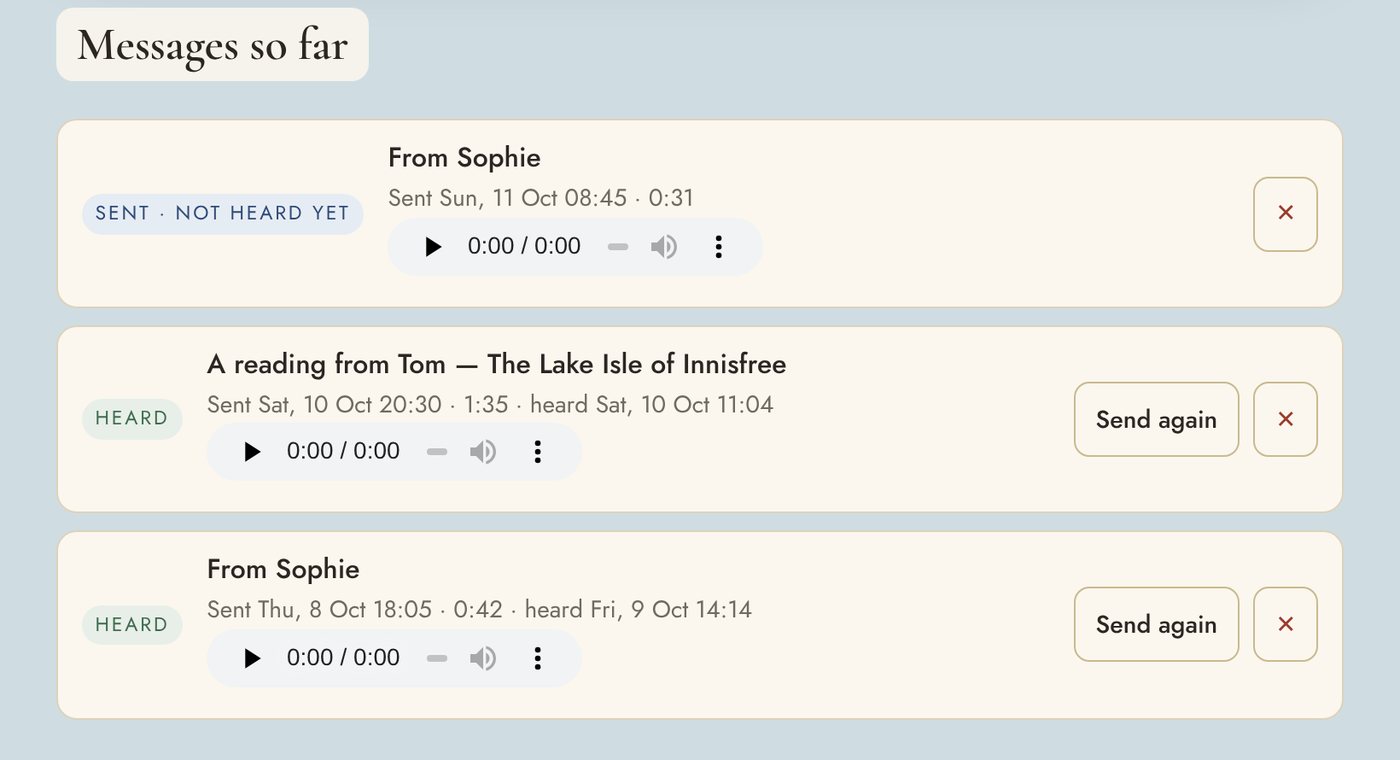
- One big Play button on a tablet, phone or laptop the resident already has. It says each title aloud and keeps the place in every book.
- Families add books and voice messages from their own phones, wherever they live, and the listening diary shows them when the resident has listened.
- Staff only keep the tablet charged. Everything else is done by the family.
If you'd like to try it in your home, write to hello@readingtoruth.com to ask about a free trial for your home.
For families: one button, kept full from your phone.
Books and voice messages for someone in a care home, sent from wherever you live. The staff only keep the tablet charged.
Founding price until 31 December 2026, then £74.99.
Pay once — £49.99Cancel any time from the family page. The player keeps everything already on it.
Start monthly — £6.99Everything included either way, for the whole family. 60-day money-back guarantee on both, from the day they first use it.
Questions people ask
What activities can blind residents in a care home do?
Anything that works by sound or touch: personal playlists, a local talking newspaper, audiobooks, handling objects from a reminiscence box, a visiting pet, and voice messages from family. Many of these are free.
What does CQC look for in care home activities?
CQC's quality statement on independence, choice and control expects people to have access to activities and the local community, and to be supported to keep up the relationships that matter to them. NICE's quality standard adds that activity should be meaningful to the person and, if they wish, involve family and friends.
How can families help with activities in a care home?
Give them a job: build a playlist, record voice messages, bring photographs and tell the stories behind them, or read aloud when they visit. Relatives who live far away can do most of this from their phones.
Is there a free trial of Reading to Ruth for care homes?
Yes. Write to hello@readingtoruth.com to ask about a free trial for your home.